
Hyperliquid Under Siege: How TradFi Giants CME and ICE Are Fighting the 24/7 Derivatives Revolution
Wall Street FEARS Hyperliquid more than any threat it has faced in decades — and once you understand why, you’ll never look at decentralized trading the same way again. Hyperliquid is currently in the crosshairs of traditional finance. Two of the biggest derivatives exchanges on the planet, the CME Group and the Intercontinental Exchange (ICE), are trying to get it shut down. They aren’t using code or better products to win. Instead, they’ve run straight to Washington to lobby the CFTC and members of Congress. This battle reveals a massive shift in how people trade and shows just how scared the old guard is of a fast, 24/7 DeFi platform.
Defining the Threat: What Hyperliquid Offers That TradFi Fears
According to a recent report by FalconX, Hyperliquid is rapidly expanding into pre-IPO markets, prediction contracts, and tokenized real-world assets — moves that have put traditional Wall Street giants like CME and ICE on high alert. Hyperliquid isn’t just another app. It is a decentralized exchange built on its own Layer 1 Blockchain. It focuses on perpetual futures, often called perps. These are trading contracts that don’t have an expiration date. They let traders use leverage to bet on price movements with high speed and low costs.
While most crypto platforms stay in the crypto lane, Hyperliquid went further. It added synthetic exposure to real-world assets (RWAs). Now, traders can bet on stocks, precious metals, and commodities like crude oil. The biggest draw is that it never closes. Traditional markets shut down on weekends and holidays. Hyperliquid stays open 24/7, 365 days a year.
The growth numbers prove people want this. During a recent conflict involving Iran, oil-linked perp volumes on Hyperliquid surged past $700 million in a single day. Traders didn’t want to wait for Monday morning to hedge their bets. They used Hyperliquid because the world doesn’t stop turning on a Friday night.
Some of the platform’s biggest wins include:
- Generating $106 million in protocol revenue in a single month last August.
- Reaching an annualized revenue run rate over $1.25 billion.
- Capturing 70% of the DeFi Perpetuals DEX market.
- Growing to 6% of the total global perpetual futures volume by early 2026.
By April 2026, seven of the top ten markets by volume on the platform were tokenized futures, not crypto pairs. This means Hyperliquid is no longer just a crypto tool. It is a global venue for trading everything from Apple stock to the S&P 500.
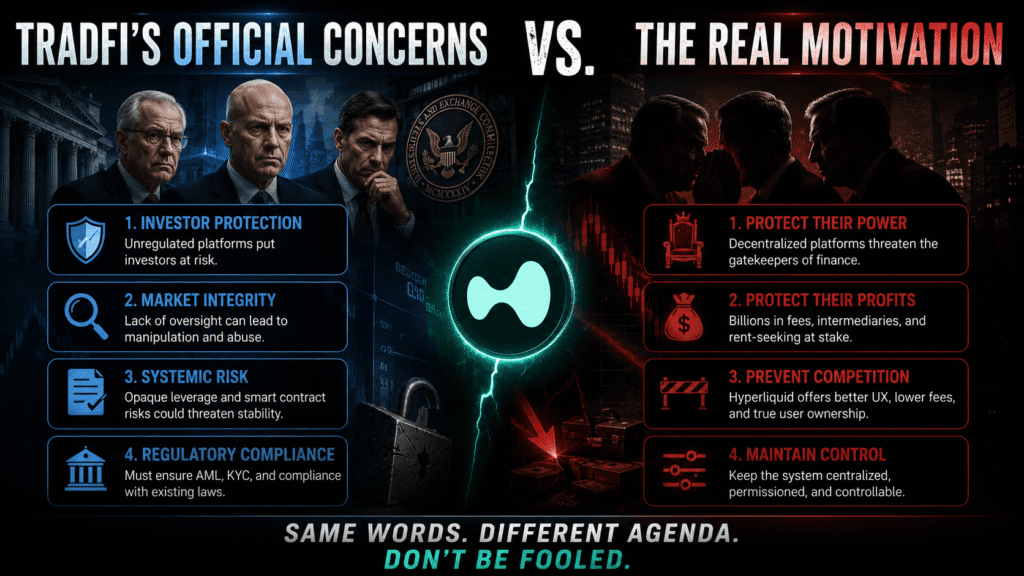
TradFi’s Official Concerns vs. The Real Motivation
When CME and ICE talked to regulators, they focused on three official problems. First, they claimed anonymous order books lead to market manipulation. They argued that bad actors could distort oil prices, which would mess up costs for airlines and refiners. Second, they pointed to sanctions. Since Hyperliquid doesn’t require KYC or AML checks, they say traders from banned countries can easily gain exposure to commodities. Third, they worried about benchmark integrity. They claim Hyperliquid’s activity could ruin the accuracy of Brent and WTI crude pricing.
But if you look closer, these arguments feel like a smokescreen. There is a glaring hypocrisy here. While the CME tells regulators that 24/7 trading is dangerous, they are building their own 24/7 markets for crypto futures and options. They don’t hate the product. They just hate that someone else is running it.
The real driver is existential competition. CME and ICE make their money by being gatekeepers. They decide what gets listed and they control the clearing process. Hyperliquid removes the gatekeeper.
The contradiction gets even wilder when you look at ICE’s bank account. ICE invested up to $2 billion in Poly Market, a crypto prediction market. Poly Market lets users bet on elections and war-related events. These markets are often flagged by the CFTC for insider trading. ICE is basically telling the government that Hyperliquid is too risky while they pour billions into a platform that regulators already distrust.
Hyperliquid’s Strategic Counter-Offensive in Washington
Hyperliquid isn’t just waiting to be sued. They are fighting back in the same arena where CME and ICE operate. In February, the protocol launched the Hyperliquid Policy Center. They funded this group with $29 million in HYPE tokens. They hired Jake Travinsky, a top crypto policy lawyer who knows how to speak the language of Capitol Hill.
The effort is hands-on. Co-founder Jeff Yan has met directly with members of Congress to explain how decentralized order books work. He isn’t trying to hide from the law. Instead, he is arguing for a new regulatory framework that fits the technology.
Hyperliquid’s main argument is that onchain trading is actually safer and more honest than TradFi.
- Every trade is verifiable on a public Blockchain.
- Every open position is visible to anyone.
- Risk management is handled by code, not a private clearing house.
The goal is to pass legislation like the Clarity Act. This would give legal recognition to onchain derivatives. If they win this fight, they stop being a target and start being a compliant market leader.
Analyzing Potential Outcomes: Bullish, Bearish, or Middle Ground?
Hyperliquid has a lot of wind in its sails. They have massive revenue, a proactive legal team, and a product that people actually use. The fact that ICE is acting so hypocritically with Poly Market gives Hyperliquid a political edge. It makes the TradFi attack look like a business move rather than a quest for safety.
However, CME and ICE have deep roots. They have decades of relationships with the people who write the laws. They have armies of compliance officers and a direct line to the CFTC. The issues with sanctions and KYC are genuinely hard to solve without changing the “permissionless” nature of DeFi.
The most likely result is a middle ground. We will probably see a regulated onchain derivatives program. It will likely require some compliance measures but keep the transparent order books and onchain settlement. This keeps the technology alive while keeping regulators happy.
Final Thoughts on the Fight for Global Markets
This is a battle over who controls the plumbing of global finance. For years, a few giant firms decided the price of everything. Hyperliquid proves that a transparent, code-based system can do the same job better and faster.
The most important takeaway is that you don’t spend millions lobbying against a competitor who isn’t a threat. The attack from CME and ICE is actually a massive bullish signal for Hyperliquid. It confirms that the platform has reached a scale where it can actually hurt the incumbents.
If Hyperliquid wins regulatory clarity, the upside for the HYPE token is huge. It would open the door for institutional money that currently only trusts the CME. If they lose, their growth will be capped, but they won’t disappear. They have already proven that the demand for 24/7 markets is real. The duopoly is cracking, and the momentum is on the side of the chain.