Disclaimer: This article is for educational purposes only and does not constitute financial or investment advice. Cryptocurrency investments carry significant risk. Always consult a qualified financial adviser before making investment decisions.
Most crypto investors only think about risk management after a painful loss — a 60% drawdown on an altcoin, a rug pull that wiped a month of gains, or an exchange collapse that froze their funds overnight. By then, the damage is done.
The investors who consistently survive in crypto are not the ones who pick the best coins. They are the ones who manage risk before anything goes wrong. This guide covers seven proven crypto risk management strategies, with real numbers, real historical examples, and the tools you need to apply them today.
What Is Crypto Risk Management?
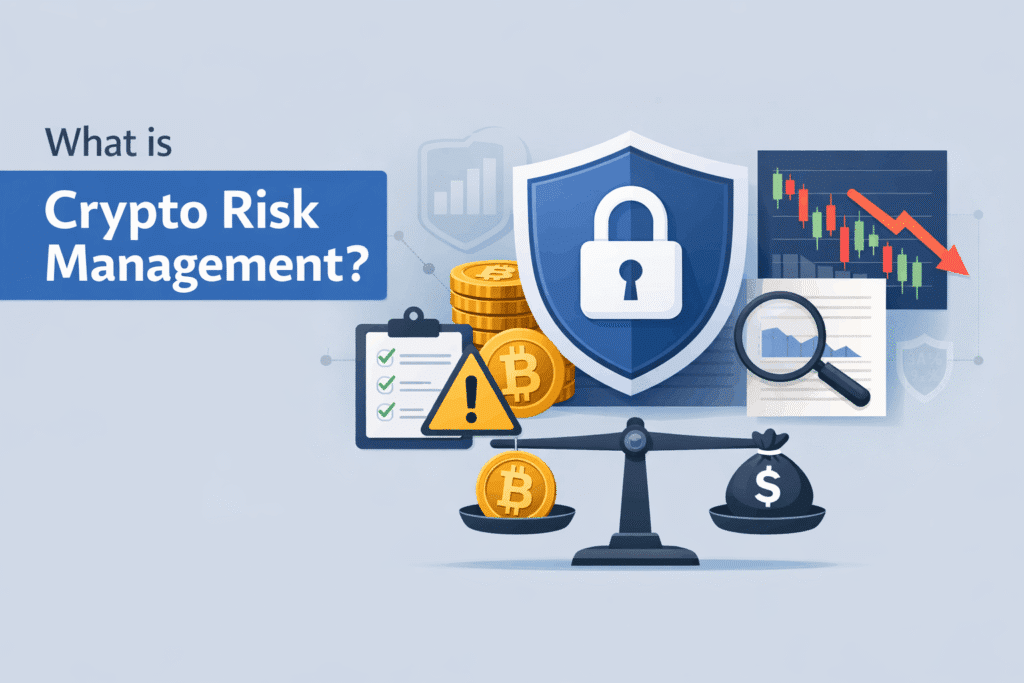
Crypto risk management is the practice of identifying, measuring, and controlling potential losses in your portfolio before they occur. It is not about avoiding risk entirely — that would mean avoiding returns. It is about making sure no single trade, market crash, hack, or black swan event can wipe you out. According to a detailed guide on modern digital asset strategy, treating risk management as a structured problem—involving position sizing, volatility management, and drawdown control—is what currently separates sophisticated investors from those who suffer significant losses during market corrections
The stakes are higher in crypto than in traditional markets for three reasons:
- No circuit breakers. Stock markets halt trading when prices drop too fast. Crypto does not. A 30% drop in 24 hours is not unusual.
- 24/7 markets. Weekend flash crashes and 3am liquidation cascades happen while you sleep.
- Custody risk. A lost seed phrase, a hardware wallet failure, or an exchange insolvency can mean permanent loss — entirely separate from market risk.
Effective cryptocurrency risk management addresses all three dimensions: market risk, volatility risk, and custody risk.
Know Your Risk Profile First
Before applying any strategy, you need to know which investor type you are. Your risk profile determines how aggressively or conservatively you should implement each strategy below.
| Profile | Typical allocation | Key priority |
| Conservative | 50%+ stablecoins, BTC/ETH only | Capital preservation above all |
| Moderate | 25% stablecoins, mix of large and mid-cap | Balanced growth and protection |
| Aggressive | 10–15% stablecoins, includes small-caps | Maximum growth, accepts higher drawdowns |
If you are not sure which profile fits you, ask yourself: how would you react if your portfolio dropped 40% next week? If the honest answer is “I would panic sell,” you are a conservative investor regardless of what you think you are.
The 7 Crypto Risk Management Strategies
Strategy 1: Position Sizing — The Foundation of Everything
Position sizing answers the most important question in trading: how much of your portfolio should you put into a single trade? The professional standard is the 1–2% rule: never risk more than 1–2% of your total account on any single position.
The formula:
Position Size = (Account Balance × Risk %) ÷ Stop-Loss Distance
Example: You have a $10,000 portfolio. You want to buy an altcoin at $5.00 with a stop-loss at $4.50. You are risking 1% ($100).
- Risk amount: $10,000 × 1% = $100
- Stop-loss distance: $5.00 − $4.50 = $0.50
- Position size: $100 ÷ $0.50 = 200 tokens ($1,000 total)
If price hits $4.50, you lose $100 — exactly 1% of your account. You live to trade another day.
Strategy 2: Stop-Loss Orders — Your Automatic Exit
A stop-loss is an instruction to your exchange to automatically sell a position when the price drops to a pre-defined level. It removes emotion from the exit decision entirely.
There are two main types:
- Hard stop-loss: Triggers at a fixed price. Example: buy ETH at $3,000, set hard stop at $2,700 (−10%).
- Trailing stop-loss: Moves upward as the price rises, locking in gains. Example: buy BTC at $60,000 with a 10% trailing stop. When BTC rises to $70,000, your stop auto-moves to $63,000.
Place stops below a key technical level — a recent support zone or a swing low — rather than picking an arbitrary percentage. This way the stop only triggers if your trade thesis is genuinely invalidated.
Strategy 3: Portfolio Diversification — Done Correctly
Owning 20 different altcoins is not diversification. If Bitcoin drops 30%, most altcoins drop 40–60% simultaneously. True diversification means spreading across uncorrelated asset types and risk tiers.
Understanding correlation: Correlation measures how closely two assets move together, on a scale from −1 (opposite) to +1 (identical). Here are approximate BTC correlations for context:
| Asset | Approx. BTC correlation |
| Ethereum (ETH) | ~0.80 |
| Large-cap altcoins | ~0.70–0.85 |
| Gold | ~0.10–0.20 |
| USDC / stablecoins | ~0.00 |
A practical framework for a $10,000 portfolio:
| Allocation | Asset type | Example | Purpose |
| 40% ($4,000) | Large-cap | BTC, ETH | Stability anchor |
| 20% ($2,000) | Mid-cap ecosystem | SOL, AVAX | Growth with lower volatility |
| 15% ($1,500) | Small-cap/high-risk | Emerging DeFi | High upside, sized small |
| 25% ($2,500) | Stablecoins | USDC | Dry powder + volatility buffer |
Strategy 4: Stablecoin Allocation — Dry Powder Always Ready
Holding a deliberate stablecoin allocation is one of the most underappreciated risk tools in crypto. It reduces your exposure during downturns and gives you capital to deploy when opportunity appears.
| Market environment | Suggested stablecoin % |
| Bull market (strong uptrend) | 10–15% |
| Neutral / sideways | 20–30% |
| Bear market or high uncertainty | 30–50% |
Stick to fiat-backed stablecoins (USDC, USDT). Algorithmic stablecoins like UST — which collapsed in May 2022 and wiped out approximately $40 billion in value in days — carry their own catastrophic risk.
Strategy 5: Dollar-Cost Averaging — Remove Timing Risk
Dollar-cost averaging (DCA) means investing a fixed amount at regular intervals rather than putting everything in at once. It eliminates the risk of buying at a peak.
Instead of investing $6,000 in Bitcoin in one transaction, you invest $1,000 per month for six months. You buy at different prices — sometimes higher, sometimes lower — and your average cost naturally smooths out. DCA works best for Bitcoin and Ethereum — high-conviction assets held over a long time horizon.
Strategy 6: Adjusting Risk by Market Cycle
Risk management is not a static set of rules — it should change with the market cycle. The same position size that makes sense in a bull market can be reckless at a cycle peak.
| Market phase | Position sizing | Stablecoin % | Stop-loss tightness |
| Accumulation (bear bottom) | Up to 2% | 20–30% | Wide — expect volatility |
| Bull market (uptrend) | 1–2% | 10–15% | Trailing stops to lock gains |
| Distribution (near peak) | 0.5–1% | 30–40% | Tight — protect profits |
| Bear market | 0.5% or pause trading | 40–50% | Hard stops, minimal exposure |
Strategy 7: Custody and Operational Risk Management
Market risk gets all the attention. Custody risk — losing your crypto to hacks, scams, or human error — is equally destructive and far more preventable.
- 3-2-1 custody rule: No more than 30% on any single exchange. Use at least two reputable exchanges. Hold long-term positions on a hardware wallet.
- Never store seed phrases digitally. Write them on paper in a secure physical location. Not in photos, not in cloud storage, not in any app.
- Use authenticator-app 2FA. Never SMS-based 2FA — it is vulnerable to SIM-swap attacks.
- Audit smart contract approvals. Use Revoke.cash regularly to remove approvals from protocols you no longer use.
Regulatory Risk — The Factor Most Investors Ignore
Regulatory risk is the possibility that government action — bans, restrictions, tax law changes, or exchange shutdowns — affects your ability to hold or trade crypto assets. It is one of the five main risk types in crypto alongside market, liquidity, smart contract, and custody risk.
How to reduce your regulatory exposure:
- Only hold assets on exchanges licensed in your jurisdiction
- Keep accurate records of all transactions for tax compliance — use tools like Koinly or CoinTracker
- Avoid assets that are the subject of active regulatory scrutiny (e.g., tokens that have been designated as unregistered securities)
- Diversify across exchanges in different jurisdictions so that a single country’s action does not freeze all your assets
The Behavioral Risk Nobody Talks About
The biggest risk in crypto is not market volatility. It is your own behaviour. The most common traps that destroy retail portfolios:
- FOMO buying: Chasing a coin after a 200% run because you fear missing out. You almost always buy the top.
- Panic selling: Selling at the bottom of a dip out of fear, locking in losses right before recovery.
- Revenge trading: Doubling position size after a loss to “win it back.” This is how small losses become catastrophic ones.
- Overconfidence after a win: Increasing risk dramatically after a lucky trade, abandoning the rules that were working.
The fix: Write your trading rules down before you open a position. Define your entry, your stop-loss, your target, and your position size in advance — in writing. When emotion hits, you follow the written plan, not the feeling in the moment. A pre-trade checklist that takes 60 seconds to complete is worth more than any indicator.
What Real Crashes Teach Us — Three Historical Case Studies
The LUNA/UST Collapse — May 2022
The TerraUSD (UST) algorithmic stablecoin lost its dollar peg in May 2022, triggering a death spiral that wiped out approximately $40 billion in value within 72 hours. Investors who held UST as a “safe” stablecoin allocation lost everything. The lesson: stablecoin allocation only works if you use genuinely fiat-backed stablecoins. Algorithmic models introduce a correlated catastrophe risk that defeats the entire purpose of holding a stablecoin.
The FTX Collapse — November 2022
FTX, at the time one of the world’s largest crypto exchanges, collapsed in November 2022 due to misuse of customer funds. Billions in customer assets were frozen or lost permanently. Investors who followed the 3-2-1 custody rule — no more than 30% on any single exchange, long-term holdings on hardware wallets — suffered partial losses. Those who kept everything on FTX lost everything on that exchange. The lesson: exchange custody risk is real and the 3-2-1 rule is not optional.
The 2022 Bear Market — 65% BTC Drawdown
Bitcoin fell from approximately $69,000 in November 2021 to around $16,000 by November 2022 — a 77% peak-to-trough decline. Altcoins fell further. Investors who maintained a 25–30% stablecoin allocation throughout entered the bear market with dry powder, avoided the worst losses, and were positioned to accumulate near the bottom. Those who were 100% invested had no capital to deploy and no cushion. The lesson: stablecoin allocation is not a missed opportunity cost — it is insurance that pays out when it matters most.
Free Tools to Manage Crypto Risk in 2026
- CoinGecko — Portfolio tracking, market cap data, and coin correlation checking. Free tier is sufficient for most retail investors.
- DeBank — Track all your DeFi positions, wallet balances, and protocol exposures across chains in one dashboard.
- Revoke.cash — Audit and revoke smart contract approvals. Run this monthly on any wallet connected to DeFi protocols.
- Koinly / CoinTracker — Tax and transaction tracking. Keeps your records clean for regulatory compliance.
- Messari — On-chain data, protocol research, and market intelligence. Useful for assessing project-level risk before entering a position.
FAQ
What is the best way to manage risk in crypto?
The single most impactful step is position sizing. Limiting each trade to 1–2% of your portfolio means no single loss is catastrophic. Combine this with stop-loss orders and a 20–25% stablecoin buffer and you have a solid foundation.
How much of my crypto portfolio should be in stablecoins?
In a neutral market, 20–30% is a sensible range. In confirmed bull markets, 10–15% is sufficient. In bear markets or periods of high uncertainty, some investors go as high as 40–50% to preserve capital for the next cycle.
What are the main types of risk in cryptocurrency?
Market risk (price volatility), liquidity risk (inability to exit at your desired price), smart contract risk (bugs or exploits in DeFi), regulatory risk (government action restricting trading or holding), and custody risk (losing access to funds through hacks or lost seed phrases).
Is diversification alone enough to manage crypto risk?
No. Diversification reduces concentration risk but does not protect against systemic downturns where most crypto assets fall together. Effective risk management combines diversification with position sizing, stop-losses, stablecoin allocation, and proper custody practices.
What percentage of my portfolio should I risk per trade?
Professional traders typically risk 1–2% of their total account per trade. Beginners should start at 1% until they have built consistent profitability over at least 30 trades.
How do I manage crypto risk during a bear market?
Reduce position sizes to 0.5–1%, increase stablecoin allocation to 40–50%, tighten stop-losses on any active trades, and move long-term holdings off exchanges and onto a hardware wallet. Bear markets reward patience and capital preservation over active trading.