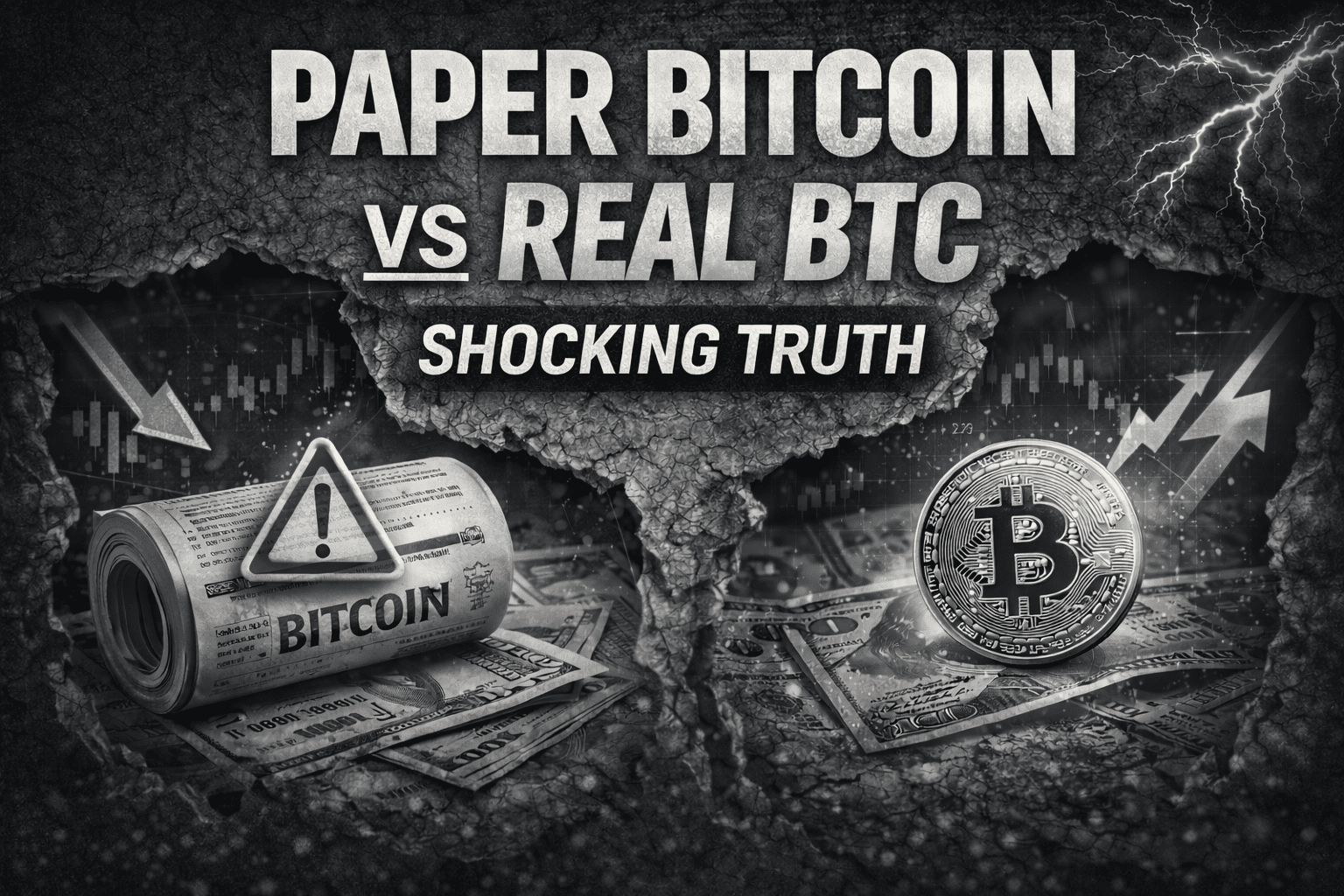
What Is Paper Bitcoin?
What is paper bitcoin? Simply put, paper bitcoin represents BTC ownership on an exchange or paper certificate — but you don’t hold the real asset. Unlike physical bitcoin, paper BTC gives you no private keys, no on-chain control, and no true ownership.
In this guide, we explain paper bitcoin vs physical bitcoin, why paper BTC is risky, and the shocking truth most exchanges won’t tell you. If you’ve ever searched “what is paper bitcoin” or bitcoin or “paper bitcoin Vs physical bitcoin” this is your complete answer.
Paper BTC vs Real BTC
Real Bitcoin means you control the private keys. Paper Bitcoin means someone else does — and you’re trusting them to actually hold what they claim. That distinction matters more than most investors realise, especially after the collapses of Mt. Gox and FTX, where millions in “paper” balances turned worthless overnight.
To understand the forces behind price moves and liquidity shifts, don’t miss our in-depth Crypto Market Mechanics Exposed guide that breaks down how the crypto market really works behind the scenes.
Paper Bitcoin vs Real Bitcoin — Full Comparison
| Feature | Real Bitcoin | Paper Bitcoin |
| You hold private keys | Yes | No |
| Verifiable on-chain | Yes | Rarely |
| Custodian risk | None | High |
| Price exposure | Direct | Indirect |
| Seizure / hack risk | Low (self-custody) | High |
| Regulatory risk | Low | High |
| Ease of purchase | Medium | Easy |
| True ownership | Yes | No |
Key Takeaways
- Paper Bitcoin Defined: Investments offering indirect exposure to Bitcoin, like futures, ETFs, and exchange balances, without direct ownership of the underlying asset.
- Concerns over Backing: Allegations suggest that the amount of paper Bitcoin may exceed the actual Bitcoin available, raising questions about reserves and solvency.
- Market Influence: Paper Bitcoin, particularly derivatives and ETFs, is believed to have a significant impact on Bitcoin’s price fluctuations.
- Transparency Issues: Many paper Bitcoin issuers, including ETFs and treasury companies, have not disclosed their wallet addresses, making verification difficult.
- Historical Precedents: Past exchange failures (Mt. Gox, FTX) highlight the risks associated with not holding actual Bitcoin directly.
- Role in Adoption: Despite risks, paper Bitcoin has played a role in making Bitcoin more accessible and attracting capital, driving adoption and price action.
- Self-Custody vs. Convenience: While self-custody aligns with Bitcoin’s ethos, paper Bitcoin offers convenience that aids mainstream adoption, though risks remain.
What Exactly Is “Paper Bitcoin”?
Paper Bitcoin has been around in a more formal sense since December 2017, when the Chicago Mercantile Exchange (CME) launched Bitcoin futures — marking the first time institutional investors could trade Bitcoin exposure on a regulated platform.
At its core, “paper assets” mean investing in something without actually holding the physical item. Take gold, for instance. Most gold trading happens through contracts like futures or ETFs, not by people actually buying and storing gold bars. Paper Bitcoin works the same way. It’s about getting exposure to Bitcoin’s price movements through things like futures contracts, options, ETFs, and trusts, all without directly owning the Bitcoin itself.
Before regulated futures, though, crypto exchanges were where most people interacted with Bitcoin. Unfortunately, some of these early exchanges had major problems. Think about Mt. Gox, which used to handle a huge chunk of global Bitcoin trades. It famously collapsed in 2014 after losing hundreds of thousands of Bitcoin due to hacks and mismanagement. Users who trusted Mt. Gox with their funds ended up with what was essentially IOUs – paper Bitcoin – leading to massive losses. Other exchanges like Bitcoinica, Bitfloor, and Bitfinex also suffered major hacks and losses over the years. More recently, FTX collapsed after allegedly using customer funds for various ventures, leaving its users with worthless account balances.
What all these situations have in common is that customer balances were recorded on exchange ledgers, but the actual Bitcoin wasn’t always there. People were holding paper balances instead of verifiable on-chain assets. This history is a big reason why there’s so much controversy and skepticism around paper Bitcoin today.
Different Types of Paper Bitcoin
Paper Bitcoin shows up in several forms, and some are much bigger than others.
- Crypto Exchanges: These are estimated to hold about 15% of Bitcoin’s total supply. They’re often the most talked about because of the history of hacks and scams. Since the FTX collapse, many exchanges have started offering “proof of reserves” to show they actually hold the crypto they claim to, though these aren’t always perfectly up-to-date.
- Bitcoin ETFs: These funds collectively hold nearly 1.6 million BTC, around 7% of the total supply. Bitcoin ETFs: These funds collectively hold nearly 1.6 million BTC — approximately 6.8% of the total supply, according to data tracked by CoinDesk — making them the single largest category of paper Bitcoin in existence. ETFs let people invest in Bitcoin’s price through a regular brokerage account without needing to manage private keys or worry about self-custody. The issue here is that many spot Bitcoin ETF issuers haven’t publicly shared their Bitcoin wallet addresses, making it hard to confirm they hold the actual Bitcoin backing their shares. Some third-party trackers have found wallets, but official disclosure is still lacking.
- Bitcoin Treasury Companies: These companies hold about 1.1 million BTC, roughly 5% of the supply. The most famous example is MicroStrategy, which started buying Bitcoin in 2020 and inspired many others. When you invest in these companies, you’re betting on their success, not directly on the Bitcoin they hold. Like ETFs, most of these companies also don’t disclose their wallet addresses, leading to questions about their actual holdings, especially when their large Bitcoin purchases don’t seem to move the market much.
- Governments: Several governments reportedly hold Bitcoin, possibly from seizures or as strategic reserves, totaling around 646,000 BTC (about 3% of the supply). The US is said to hold the most. However, like treasury companies and ETFs, most governments don’t reveal their wallet addresses, making it unclear how much they truly possess. This category is unique because government holdings can influence geopolitical narratives and monetary policy.
- DeFi (Wrapped Bitcoin): This involves Bitcoin on other Blockchain, often in the form of “wrapped Bitcoin” (like WBTC). These are ERC-20 tokens supposedly backed 1:1 by actual Bitcoin and are used in decentralized finance for things like lending and yield farming. While most wrapped Bitcoin protocols do offer proof of reserves, making verification possible, handing your Bitcoin to a custodian still carries risks. Currently, these protocols hold over 380,000 BTC, just under 2% of the supply.
How Paper Bitcoin Affects BTC’s Price
Paper Bitcoin has generally had a positive impact on Bitcoin’s price, both directly and indirectly, mainly by making Bitcoin more accessible and attracting more money into the market.
- Exchanges: They’ve made buying Bitcoin much simpler and safer than the old peer-to-peer methods. They also offer tools like futures, which are important for price discovery and market liquidity. Without exchanges, Bitcoin trading would be much less active and might have faded away.
- CME Bitcoin Futures (2017): While not directly investing in the asset, these futures legitimized Bitcoin for institutional investors, indirectly boosting its profile.
- MicroStrategy (2020): Their move to buy Bitcoin as a treasury asset was a direct impact because they bought actual BTC, and an indirect one by further increasing Bitcoin’s legitimacy.
- Spot Bitcoin ETFs (2024): These have been incredibly bullish for paper Bitcoin. They were a major factor in pushing Bitcoin to its all-time high. When ETFs see large inflows, Bitcoin’s price tends to rise, and outflows often lead to price drops.
- Governments: Their impact is mostly indirect. By holding or seizing Bitcoin, they reduce the available supply on the market. Less supply, with steady or rising demand, naturally pushes prices up. Their continued holding also signals confidence in Bitcoin.
- Wrapped Bitcoin (DeFi): This has had a subtle but direct effect by making it easier for people to use Bitcoin as collateral for loans. This might mean fewer people sell Bitcoin to get cash, as they can borrow against it instead. However, this leverage can also lead to significant liquidations during volatile market swings.
Allegations and Controversies
Is BlackRock’s Bitcoin ETF Backed by Real Bitcoin?
BlackRock’s iShares Bitcoin Trust (IBIT) officially holds spot Bitcoin and uses Coinbase Custody as its custodian. Analysts at Bloomberg Intelligence have confirmed the fund purchases real BTC — not derivatives or synthetic instruments. However, BlackRock has not publicly disclosed its wallet addresses, meaning independent on-chain verification by ordinary investors remains impossible.
Third-party researchers have identified wallets potentially linked to IBIT, but without official confirmation these remain unverified. For most investors, the practical takeaway is this: IBIT is almost certainly backed by real Bitcoin, but you are trusting BlackRock’s reporting and Coinbase’s custody rather than verifying it yourself on-chain — which is the fundamental trade-off of all paper Bitcoin.
Does MicroStrategy Have Proof of Bitcoin Reserves?
MicroStrategy holds approximately 1% of Bitcoin’s entire circulating supply, making it the largest corporate Bitcoin holder in the world. Despite this, the company has repeatedly declined to publish wallet addresses or provide cryptographic proof of reserves, citing security concerns and potential market impact.
CEO Michael Saylor has publicly stated that MicroStrategy buys real Bitcoin, uses regulated custodians, and does not engage in rehypothecation. The company does undergo standard financial audits, which indirectly confirm holdings — but these are traditional accounting audits, not on-chain verifiable proof. Critics argue that without wallet disclosure, the same trust-based risk present in ETFs applies here too. Until MicroStrategy publishes verifiable on-chain proof, their holdings remain paper Bitcoin from a verification standpoint.
The Future of Paper Bitcoin
While paper Bitcoin carries risks, many of these concerns stem from Bitcoin’s earlier, less secure days. Today, paper Bitcoin, especially through ETFs, plays a significant role in supporting the crypto ecosystem, driving both adoption and price action.
Ideally, everyone would manage their own private keys, embodying Bitcoin’s core principles of true ownership and censorship resistance. However, self-custody is still a major hurdle for mainstream adoption due to its perceived complexity. Thankfully, wallets are becoming more user-friendly, making it easier for everyday people to manage their crypto securely.
For those seeking alternatives, wrapped Bitcoin offers a way to use Bitcoin in DeFi, potentially earning yield. Its reserves are transparent and verifiable on-chain, unlike much of the opaque paper Bitcoin market.
Interestingly, a new development allows Bitcoin ETF shares to be exchanged for the actual physical Bitcoin backing them. This could potentially serve as a model for other markets, like gold ETFs, allowing traditional finance to be improved by crypto’s innovations.
FAQ
Q1: What is paper Bitcoin?
A1: Paper Bitcoin is any financial instrument that gives you exposure to Bitcoin’s price without actual ownership of the underlying BTC. This includes ETFs, exchange balances, futures contracts, and corporate treasury holdings — none of which give you private key control.
Q2: What is the difference between paper Bitcoin and real Bitcoin?
A2: Real Bitcoin means you hold the private keys and control the asset on-chain. Paper Bitcoin means a third party holds the BTC on your behalf — exposing you to custodian risk, regulatory risk, and potential loss if that entity fails.
Q3: Is buying Bitcoin on Coinbase considered paper Bitcoin?
A3: Yes — until you withdraw to a self-custody wallet, your Coinbase balance is an IOU. If the exchange collapses, as FTX did in 2022, you may not recover your funds.
Q4: Does BlackRock’s Bitcoin ETF hold real Bitcoin?
A4: BlackRock’s IBIT claims to hold spot Bitcoin and uses Coinbase as its custodian. However, wallet addresses have not been officially disclosed, making independent on-chain verification difficult.
Q5: How much of Bitcoin’s supply is paper Bitcoin?
A5: Approximately 27–30% of Bitcoin’s circulating supply exists in paper form — including exchange balances (~15%), ETFs (~7%), corporate treasuries (~5%), and government holdings (~3%).


![Read more about the article Stop Loss vs Liquidation Crypto…[What Nobody Tells You]](https://cryptonomicshub.com/wp-content/uploads/2026/03/ChatGPT-Image-Mar-2-2026-10_49_52-AM-1-300x200.png)
![Read more about the article “EXPOSED: BlackRock Crypto Takeover [No One’s Telling You]”](https://cryptonomicshub.com/wp-content/uploads/2026/05/ChatGPT-Image-May-17-2026-09_35_19-PM-1-300x169.png)