
The ECB’s Secret War on Tether: How Europe is Challenging Dollar Dominance
Tether is more than just a tool for crypto traders. According to an official ECB speech, stablecoins have surged past $300 billion, with nearly 90% of the market controlled by Tether and Circle — a dominance that European policymakers view as a direct threat to monetary sovereignty. Every single USDT printed is a vote against the euro. It acts as a quiet extension of US financial power that reaches into every corner of the globe. Christine Lagarde and the European Central Bank (ECB) see this as a direct threat. Over the last 18 months, they have built a regulatory weapon to break the dollar’s grip on stablecoins before it is too late.
The ECB is worried about digital dollarization. This happens when people stop using their own local money and switch to dollar-backed tokens. When a European citizen swaps euros for USDT, that money leaves the European banking system. It goes straight into US Treasuries. This weakens the ECB’s control over its own money and makes the US government stronger. We are seeing a clash between two superpowers over who controls the future of money.
Tether’s Massive Footprint and the Treasury Connection
The numbers are staggering. As of May 2026, the stablecoin market sits at around $322 billion. A shocking 98% of that market is tied to the US dollar. Tether alone owns roughly $190 billion of that share. This gives a private company an insane amount of power over global liquidity.
Tether isn’t just a crypto firm; it is one of the biggest creditors to the US government. It holds about $141 billion in US Treasury exposure. This makes Tether the 17th largest holder of US government debt in the world. It holds more American debt than entire countries like Germany or South Korea.
This creates a cycle that hurts the euro:
- People in places like Lagos or Buenos Aires buy USDT to escape inflation.
- Europeans convert euros to USDT for trading or savings.
- This demand forces Tether to buy more US Treasuries.
- The US dollar gets stronger while the ECB loses its grip on monetary policy.
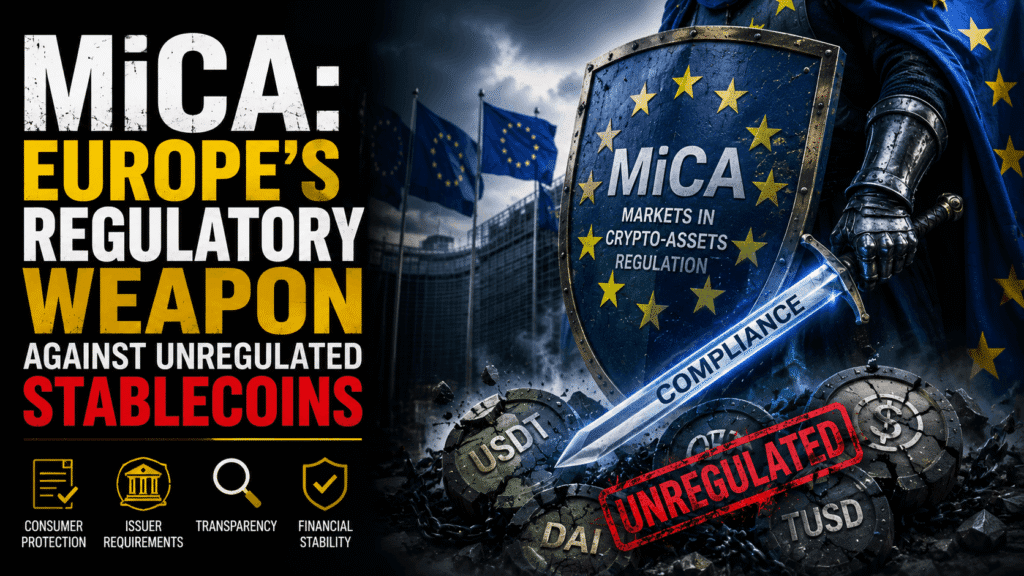
MiCA: Europe’s Regulatory Weapon against Unregulated Stablecoins
Europe created MiCA to stop this trend. At first glance, it looks like normal rules about licensing and consumer protection. But MiCA is actually a tool to push out non-EU currencies. It labels USDT as an electronic money token denominated in a non-EU currency. This triggers two very strict rules.
First, the issuer must keep at least 30% of its reserves in EU banks. Tether CEO Paulo Arduino refused to do this. He says putting reserves in fragile EU banks creates more risk, not less. Because of this, Tether never applied for a MiCA license.
Second, Article 23 acts as a kill switch. If a non-euro stablecoin exceeds 1 million transactions per day or €200 million in daily volume in the EU, the issuer must stop issuing the token immediately. This isn’t a fine. It is a hard stop designed to kill dollar stablecoins in Europe.
The results are already here. Coinbase EU pulled USDT last year. Binance and Kraken restricted how users can trade it. By the second quarter of 2025, USDT trading volumes in the EU crashed by over 70%. USDC stepped into that gap and nearly doubled its volume overnight. The final cutoff for all loopholes is July 1, 2026.
The Endgame: The Digital Euro and Tokenized Finance Infrastructure
Many people think the digital euro is just a new way to pay for coffee. That is a mistake. Europeans already have great payment systems like SEPA and contactless cards. The retail side isn’t the point. The real goal is for the ECB to own the rails of institutional finance.
The ECB is building two main pieces of tech:
- Pontis: Launching in September 2026, this links Blockchain platforms to the ECB’s settlement system. It allows assets to settle in central bank money instead of USDT.
- AIA: This is a roadmap for a full European tokenized financial system by 2028.
The retail digital euro will pilot in late 2027 and launch fully in 2029. The ECB wants to make sure that if you do serious business in Europe, you use their rails. They don’t want the financial system running on tokens printed by a company in El Salvador.
America’s Counter-Strategy: Cementing Dollar Supremacy
While Europe tries to block the dollar, the US is doing the opposite. On July 18, 2025, President Trump signed the Genius Act. This law creates a federal license for stablecoins and requires them to be backed 1:1 by cash or short-term US Treasuries.
This is a brilliant strategic move. By forcing stablecoins to hold Treasuries, the US creates a permanent, growing demand for its own debt. Galaxy Research thinks this could lower T-bill yields by 3 to 5 basis points by 2030. This saves the US government billions in borrowing costs.
The two superpowers have opposite playbooks. Europe uses restriction to protect the euro. America uses regulation to amplify the dollar. Tether is caught right in the middle of this fight.
Why Tether is Ground Zero
You might wonder why the ECB hates Tether more than Circle. The answer is simple: Circle plays by the rules. Circle got an EMI license in France and is pursuing a US IPO under the ticker CRC. They are compliant in both the US and the EU.
Tether is the opposite. It stays offshore in El Salvador to avoid regulators. It uses attestations instead of full audits. Paulo Arduino has even mocked the digital euro. Instead of complying, Tether built a resilience stack. They now hold 154 tons of gold and $7 billion in Bitcoin alongside their Treasuries.
Tether is also incredibly profitable. It made over $10 billion in net profit in 2025. That is more than most big European banks make in a year. For the ECB, breaking Tether is a way to show the world that European rules are not optional.
The tension peaked when Tether froze $344 million linked to Iran in April. European regulators didn’t cheer. They saw a private company acting like a government, weaponizing the dollar without any EU input. It showed them that Tether has more power over the European internet than the EU does.
Final Thoughts
This is a war over who controls the next 50 years of money. In the short term, Circle is the winner because it has a regulatory moat. USDT is being walled off from European liquidity. Smaller EU exchanges may even shut down because MiCA costs are too high.
Keep an eye on these dates:
- July 1, 2026: Hard MiCA enforcement.
- July 18: Final Genius Act rules.
- September: Launch of Pontis and BRICS Pay.
The dollar is losing the war with other governments but winning the war with regular people. While BRICS nations build new systems, their citizens are still buying USDT. This is why the ECB is fighting so hard. Whoever owns the digital rails owns global finance. Expect more pressure on Tether and a faster push for the digital euro as this currency war heats up.