Tokenized Assets: How Crypto is Eating TradFi’s Lunch and Rebuilding Global Finance
The Crypto vs TradFi battle that once seemed impossible to call has finally reached its tipping point — and the winner is about to change everything you thought you knew about money. According to the World Economic Forum, tokenized securities and deposits are rapidly enabling seamless capital flows that connect global markets in ways traditional finance never could — and this shift is only accelerating. Crypto is finally doing what it promised years ago. It is not just building a new system on the side. It is taking the old tools of Wall Street and rebuilding them on a Blockchain. This process is called tokenization, and it is moving stocks, bonds, and gold onto the chain. While many people chase the next meme coin, the real money is moving into tokenized assets.
Real-World Assets, or RWAs, are growing faster than any other part of the crypto market. They might not seem as flashy as a coin that goes 100x in a week. But the numbers show a massive shift in how people invest. We are seeing the core pipes of the financial world get replaced by crypto rails.
Exploding Growth: The Data behind the RWA Surge
The growth of tokenized assets is hard to ignore. A Coin Gecko report shows the RWA market cap more than tripled since early 2025. It jumped 256% from $5.4 billion to $19.3 billion by the end of Q1. This happened while most of the crypto market felt flat.
Tokenized stocks are a huge part of this trend. They let you trade the stock market without the usual rules. You do not have to worry about where you live or wait for the market to open at 9:30 a.m. on Monday. You can buy Apple or Tesla shares at 2:00 a.m. on a Sunday.
The numbers for tokenized stocks are wild:
- Market cap grew from $2 million at launch in mid-2025 to $486 million by Q1.
- Spot trading volumes hit $15.1 billion in Q1 alone.
- This beat the $14.8 billion traded in the entire second half of last year.
Treasuries and commodities are following the same path. Tokenized treasuries grew 225%, moving from $4 billion to nearly $13 billion. Tokenized commodities rose 290%, hitting over $5.5 billion. Gold drove most of that growth. In Q1, tokenized gold trading hit $90 billion, which is more than all of 2025 combined.
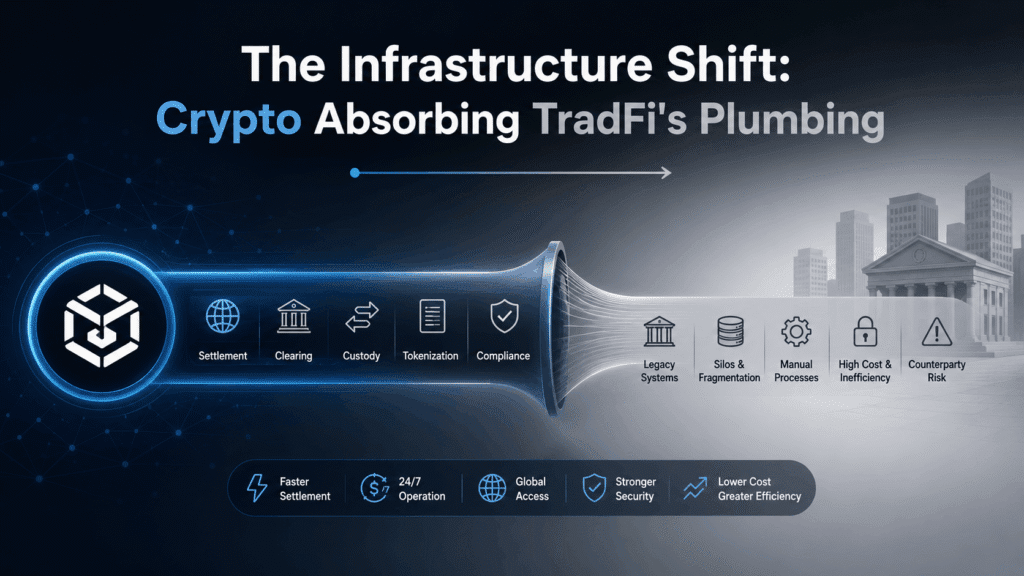
The Infrastructure Shift: Crypto Absorbing TradFi’s Plumbing
The real action is in RWA perpetual futures. Trading volumes for these hit over $524 billion in Q1 of this year. For context, only $313 billion was traded in all of 2025. This is the fourth quarter in a row that this sector has grown, even when the rest of crypto struggled.
Crypto is no longer just building a “backup” system. It is starting to own the actual tools TradFi uses. A great example is the crypto exchange Bullish buying Equinity for $4.2 billion. Most people have never heard of Equinity, but they are a huge transfer agent.
Equinity handles the boring but vital parts of the market:
- Keeping records for over 2,500 public companies.
- Managing dividends and proxy voting.
- Processing $500 billion in payments every year.
By buying Equinity, crypto firms aren’t just disrupting the system from the outside. They are buying the system itself. TradFi is struggling with thin margins and slow growth. Crypto firms have the cash and a vision for a system that never sleeps. We are moving toward a world where TradFi is just the pretty face on the front end, while crypto does all the hard work in the back.
The Fundamental Advantage: 24/7 Markets and Instant Settlement
Legacy finance has a huge flaw: it turns off. Imagine it is 3:00 a.m. on a Sunday and a war breaks out. Oil prices will likely spike and gold will rally. In the old system, you can read the news but you cannot trade. You have to wait until Monday morning. By then, the price has already jumped, and you missed your chance.
Crypto solves this. On the Hyperliquid platform, oil futures volume hit $1.7 billion during recent geopolitical tension. That was 250 times higher than normal. People traded oil and gold while the New York Stock Exchange was closed.
This 24/7 access makes markets more efficient. You don’t have to hold risky positions over a weekend and hope nothing breaks. News gets priced into the asset instantly. You get global liquidity and instant settlement instead of waiting three days for a bank to clear a trade.
Stablecoins make this possible. They are basically tokenized versions of the US dollar. Without them, 24/7 markets would not work because you can’t settle trades in a currency that takes days to move. Stablecoins are borderless and work instantly. They are the money layer for this new system.
Institutional Validation and Future Trajectory
The biggest names in finance are already moving. Visa is one of the most cautious companies in the world, but they are all in on stablecoins. Their stablecoin settlement pilot reached a $7 billion annual run rate. They now support nine different Blockchain, including Ethereum, Solana, and Avalanche.
Other giants are doing the same:
- PayPal launched PYUSD, which has a market cap over $3 billion.
- Stripe bought the infrastructure layer Bridge for $1.1 billion.
- Revolut lets users swap dollars for USDT or USDC without fees.
These companies aren’t doing this for fun. They realize that crypto rails are faster and cheaper. BlackRock CEO Larry Fink has said that everything will eventually be tokenized. He believes stocks, bonds, and funds will all live on a Blockchain.
Some people thought Wall Street was taking over crypto through ETFs. It is actually the other way around. Crypto is absorbing TradFi. The banks and regulators will still exist, but the pipes they use will be crypto pipes.
Positioning for the RWA Opportunity
If you want to get involved in this shift, you don’t need a venture capital fund. You just need a wallet. Platforms like BitGet have built tools to make this easy. Their TRDFI platform lets you trade tokenized stocks, commodities, and forex using USDT.
You can trade Apple or Microsoft stocks and precious metals like gold and silver without leaving the Blockchain. They also have a tool called IPO Prime. This lets regular users speculate on pre-IPO valuations, something that used to be only for the ultra-rich.
Many of these platforms offer high liquidity and low slippage. Some even provide bonuses for new users who deposit and trade. It is a way to get exposure to the old world of finance using the tools of the new world.
Final Thoughts
The power shift in global finance is happening right now. Crypto is no longer just a place for speculators to buy digital art or meme coins. It is becoming the foundation for how all value moves.
By owning the settlement layers and providing 24/7 access, crypto is fixing the broken parts of TradFi. We are seeing a future where the “plumbing” of finance is transparent, instant, and open to everyone. Crypto didn’t just build a better app; it built a better engine. The old system isn’t disappearing, but it is finally getting the upgrade it needed.