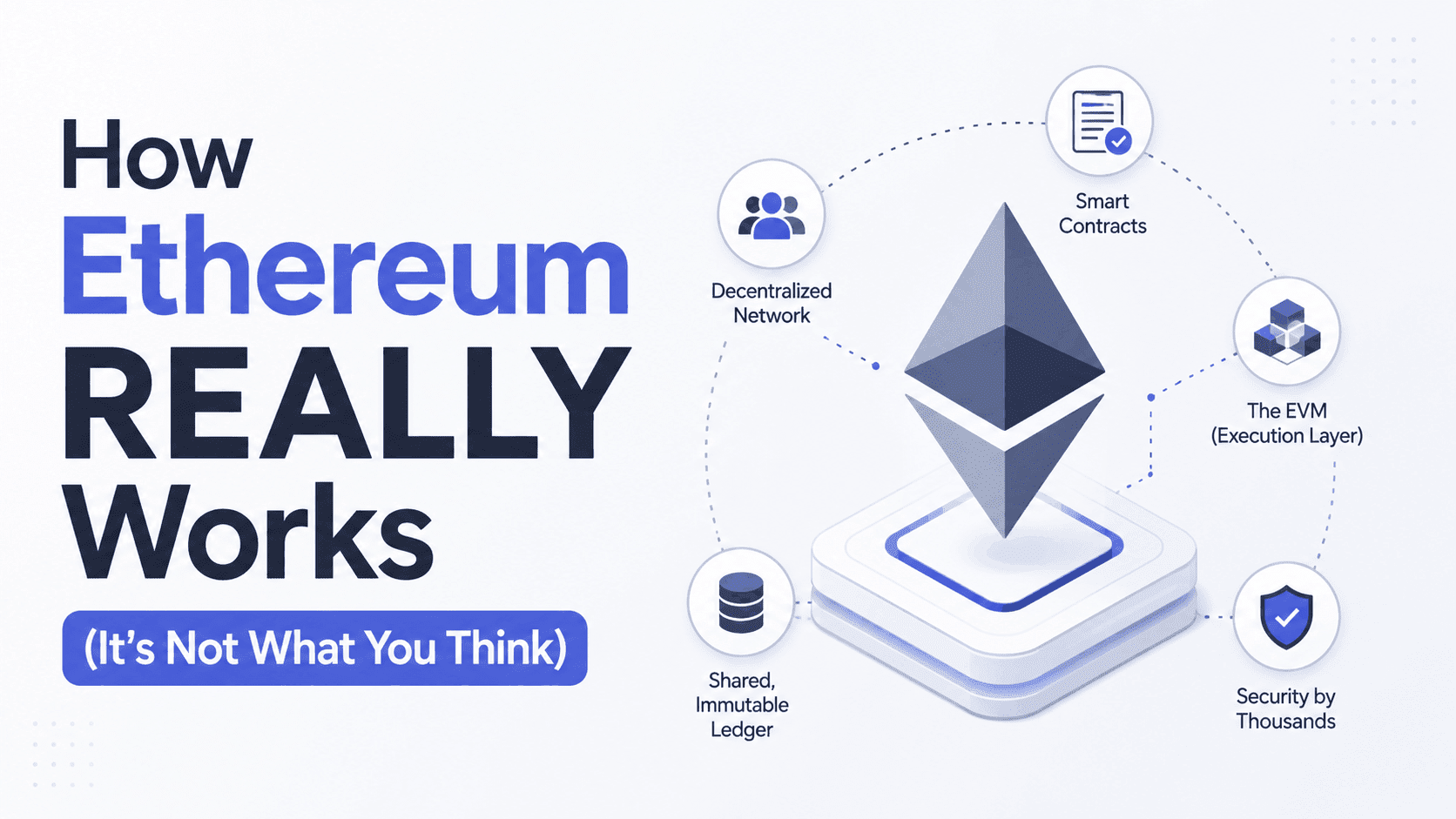
The Ultimate Guide to Understanding Ethereum in 2026: Technology, Scalability, and Future Roadmaps
If you think Ethereum is just another cryptocurrency, you’ve already missed the point — understanding how Ethereum really works in 2026 means seeing it for what it actually is: the unstoppable, programmable backbone of a financial revolution most people still haven’t woken up to. Most people know it’s the second largest coin after Bitcoin, but few actually get how it works today. It isn’t just a currency you buy and hold. It’s a massive network that runs apps and handles billions in assets. If you want to know where it stands in May 2026, you need to look past the price chart.
The Foundation: History, Core Purpose, and the ETH Asset
Vitalik Buterin and seven other co-founders started Ethereum in 2013. It officially launched in 2015. They didn’t want to just make another version of money. Their goal was to build a global decentralized computer. This allows developers to build decentralized applications, or DAPs, that Bitcoin just can’t handle.
For years, Ethereum used a proof-of-work system. This meant miners used powerful hardware to secure the network. That changed in 2022 when the network switched to proof-of-stake. Now, validators do the work. They lock up their ETH to keep the network safe and earn a yield in return.
ETH is more than a token. It’s the fuel for the whole system. You use it to:
- Pay for transaction fees (gas).
- Secure the network through staking.
- Run smart contract functions.
- Send value to other people.
The network also burns a bit of ETH with every transaction. This removes coins from the supply, which can make the asset scarcer over time.
Ethereum’s Evolution: From Single Chain to Layered Ecosystem
Ethereum’s growth into a layered ecosystem didn’t happen overnight. What began as a single chain network has evolved into a multi layered architecture, where Layer 2 networks now extend Ethereum’s capabilities while inheriting its security- a shift officially documented by the Ethereum’s foundation itself. At first, Ethereum did everything on one chain. This worked until too many people joined. When the network got crowded, it became slow and expensive. Transactions backed up like a traffic jam. To get your trade through, you had to pay higher fees to jump the line.
To fix this, developers built Layer 2s, or L2s. These are separate networks that sit on top of the main Ethereum chain. L2s process most of the work off-chain and then send a summary back to the mainnet. This gives you the speed of a fast network with the security of Ethereum.
Today, Ethereum is a layered system. It includes the mainnet, L2s, wallets, validators, and bridges. This setup lets the network grow without crashing.
Gas fees are the cost of using this computer. They stop people from spamming the network with useless data. Back in 2021, some users paid $100 just to swap tokens. Now, the average mainnet fee is around 40 cents. On L2s, fees are often a fraction of a penny.
The Engine Room: Smart Contracts and User Interaction
Smart contracts are the real secret to Ethereum’s success. These are bits of code that run automatically when certain rules are met. No boss or company has to approve the trade. The code just does it.
This technology created Decentralized Finance, or DeFi. DeFi lets you trade, lend, or borrow without a bank. You don’t have to trust a middleman with your money. The smart contract handles the swap. If the rules aren’t met, the trade doesn’t happen and you keep your funds.
To use any of this, you need a wallet. There are two main types:
- Hot Wallets: Apps or browser extensions. They’re free and fast but stay online, which makes them easier to hack.
- Cold Wallets: Hardware devices that keep your keys offline. They cost money, but they’re much safer.
Ethereum is the most trusted spot for these apps. It’s never had a major outage since 2015. Because it’s so secure, big banks and firms use it. It currently holds about 52% of all value locked in DeFi. It also dominates stablecoins and tokenized real-world assets.
Solving the Blockchain Trilemma: Rollups and Recent Upgrades
Every Blockchain struggles with the “trilemma.” This is the struggle to balance security, decentralization, and scalability. If you want high security and a decentralized network, you usually lose speed. Ethereum chose security and decentralization first.
To get the speed back, Ethereum uses rollups. A rollup takes a big group of transactions, bundles them into one, and posts the result to the mainnet.
There are two main kinds of rollups:
- Optimistic Rollups: These assume transactions are valid unless someone proves otherwise. Examples include Arbitrum and Base.
- ZK Rollups: These use math proofs to prove every batch is correct. Examples include ZkSync and Starknet.
Optimistic rollups are more common right now, but ZK rollups are more efficient in the long run.
Recent updates have made the user experience much better. The Pectra upgrade brought account abstraction (EIP-7702). This lets wallets act like smart contracts. Now you can have gasless transactions and better ways to recover lost accounts.
The Fesaka upgrade focused on data. It introduced Peer Data Availability Sampling (EIP-7594). This means nodes only need to download a tiny slice of data to confirm it exists. It cut data needs by about 87%. Fesaka also added passkey support, so you can use your fingerprint or face ID to sign trades.
The 2026 Roadmap: Future Development and Strategic Direction
Ethereum isn’t done growing. The next big update is Glamsterdam. This upgrade introduces parallelization. Right now, Ethereum processes trades one by one in a single lane. Glamsterdam adds more lanes so multiple trades can happen at once. This keeps the network fast even when it’s busy.
After that comes the Heota upgrade. This one focuses on statelessness and state expiry. Basically, nodes won’t have to store the entire history of the blockchain. This makes the hardware requirements lower and the system more efficient.
The Ethereum Foundation also has a “straw map” for the future. These are goals they want to hit by 2030:
- Near-instant transaction finality.
- Much higher throughput.
- Built-in privacy features.
- Better links between L1 and L2.
- Protection against quantum computers.
Vitalik Buterin has said that relying only on L2s isn’t a long-term fix. He wants a better balance where both the base layer and the L2s are strong.
2026 Outlook: Bull Case vs. Critical Challenges
The bull case for Ethereum is strong. It’s the top choice for institutional money. Big firms don’t mind paying a bit more for gas if it means their billions are safe. Its lead in DeFi and real-world assets gives it a huge moat.
But there are real problems. Liquidity fragmentation is a big one. Because there are so many L2s, users and money are split up. Moving funds between chains requires bridges, which can be confusing and risky for new users.
There’s also a centralization risk with L2s. Many L2s use a single sequencer node. If that node goes down, the network stops. Some people argue this makes the whole Ethereum system less decentralized.
Finally, there’s the risk of market shift. If people move to private chains or centralized platforms, Ethereum might provide the tech but lose the profit. If fees flow to other networks, ETH’s price might not see the upside.
Final Thoughts
Ethereum has a massive lead in tech and trust. It’s the most secure place for smart contracts. While it’s not the fastest or cheapest, its roadmap shows it’s getting there. The focus now is on making it easier to use and fixing the split between L2s.
If the team can simplify the user experience and keep the network decentralized, Ethereum will stay on top. The pipeline of updates like Glamsterdam and Heota shows they aren’t slowing down. Whether you’re a developer or an investor, Ethereum is the core of the decentralized web. Keep an eye on those L2s and the upcoming hard forks to see if it can maintain its crown.