The 70/30 Rule in Investing: A Complete Guide to Asset Allocation
The 70/30 rule in investing is one of the most practical portfolio strategies available to everyday investors — and one of the most misunderstood. At its core, it splits your portfolio into 70% stocks for long-term growth and 30% bonds or fixed-income assets for stability. But knowing the split is only the beginning.
This guide goes beyond the definition. You’ll learn why the 70/30 rule works, who it’s actually suited for, how to build it step by step using low-cost ETFs, how it compares to similar strategies like the 60/40 and 80/20 splits, and how to manage it over time.
Key Takeaways
- The 70/30 rule allocates 70% of your portfolio to equities (stocks, index funds, ETFs) and 30% to fixed-income assets (bonds, Treasury securities).
- This allocation has historically delivered solid long-term returns while offering meaningful downside protection during market downturns.
- The strategy is best suited to investors aged 30–55 with a medium-to-high risk tolerance and an investment horizon of 10 or more years.
- You can implement the entire strategy with just two low-cost ETFs.
- Annual rebalancing is essential to maintain the intended allocation over time.
What Is the 70/30 Rule in Investing?
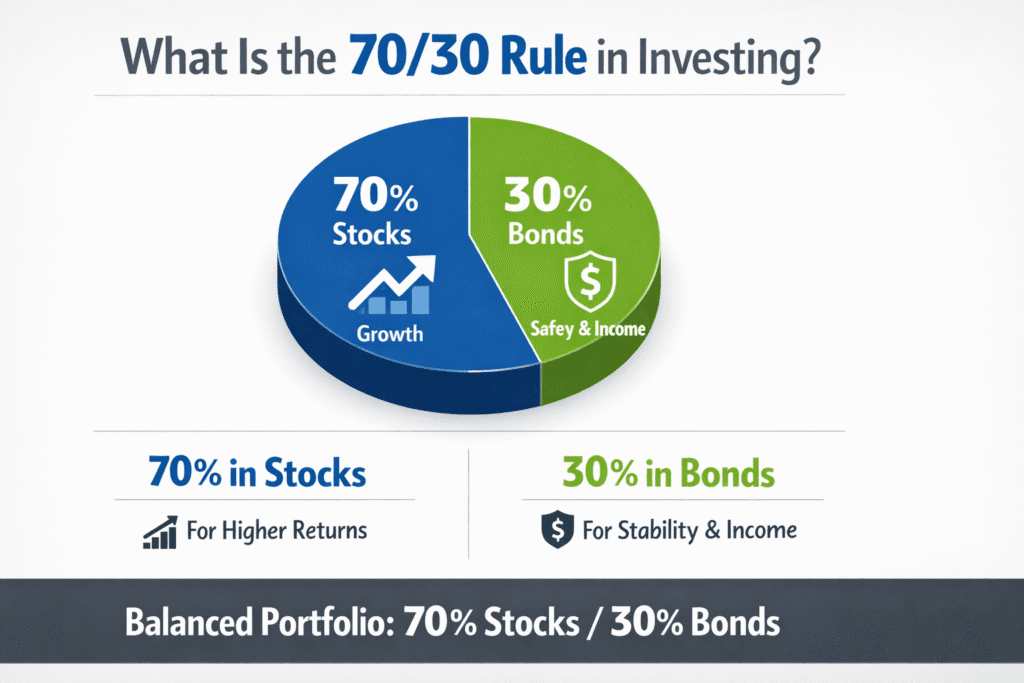
The 70/30 rule is an asset allocation strategy that divides your investment portfolio into two distinct buckets:
- 70% in equities — stocks, equity ETFs, or index funds that track broad markets like the S&P 500 or total stock market.
- 30% in fixed income — bonds, bond ETFs, or U.S. Treasury securities that provide stability and consistent income.
The 70/30 rule sits between two other popular strategies — the more conservative 60/40 split and the more aggressive 80/20 allocation — and is widely considered the right middle ground for investors with a medium-to-high risk tolerance and a time horizon of a decade or more. The logic is straightforward. Stocks drive growth over the long term — historically, the S&P 500 has delivered an average annual return of roughly 10% since its inception. But stocks are volatile. A pure equity portfolio can lose 30–50% of its value in a severe bear market, which causes many investors to panic-sell at exactly the wrong time.
Bonds act as a counterbalance. They tend to hold their value (or even appreciate) when stocks fall. The 30% allocation in bonds is large enough to meaningfully cushion drawdowns, but small enough not to drag significantly on long-term performance.
The result is a portfolio designed to grow aggressively over decades while staying stable enough that you won’t abandon it when markets get rough.
How Does the 70/30 Rule Perform Historically?
Understanding the numbers behind the 70/30 split helps you commit to it during market volatility.
| Metric | 100% Stocks | 70/30 Portfolio | 60/40 Portfolio |
| Average Annual Return (1926–2023) | ~10.3% | ~8.9% | ~8.1% |
| Worst Single-Year Loss | -43.1% (1931) | -30.7% | -26.6% |
| Best Single-Year Gain | +54.2% (1933) | +38.5% | +32.3% |
| Years with a Loss | ~30% of years | ~25% of years | ~22% of years |
Source: Vanguard Portfolio Allocation Models (historical data)
What this tells you: the 70/30 portfolio gives up about 1.4% in average annual return compared to an all-stock portfolio, but reduces your worst-year loss by more than 12 percentage points. For most investors, that tradeoff is worth it — because staying invested during downturns matters more than chasing maximum returns.
Who Is the 70/30 Rule Best For?
The 70/30 split is not a one-size-fits-all solution. It performs best for investors who meet most of these criteria:
Age range: 30–55 Young investors in their 20s might benefit from a more aggressive 90/10 or 100% equity approach since they have decades to recover from losses. Investors approaching or in retirement typically shift toward a 60/40 or 50/50 split to preserve capital.
Time horizon: 10+ years The equity-heavy side of the 70/30 portfolio needs time to recover from market downturns. If you need the money in five years or less, a more conservative allocation is likely more appropriate.
Risk tolerance: Medium-to-high You should be comfortable watching your portfolio drop 25–30% in a severe bear market without selling. If that thought causes significant anxiety, consider the 60/40 allocation instead.
Goal: Long-term wealth building This strategy works well inside a 401(k), IRA, or general investment account for retirement savings, building generational wealth, or achieving financial independence.
70/30 vs. 60/40 vs. 80/20: Which Is Right for You?
| Strategy | Stock % | Bond % | Best For | Risk Level |
| 80/20 | 80% | 20% | Younger investors, high risk tolerance | High |
| 70/30 | 70% | 30% | Mid-career investors, medium-high risk | Medium-High |
| 60/40 | 60% | 40% | Near-retirement or conservative investors | Medium |
| 50/50 | 50% | 50% | At or in retirement, capital preservation | Medium-Low |
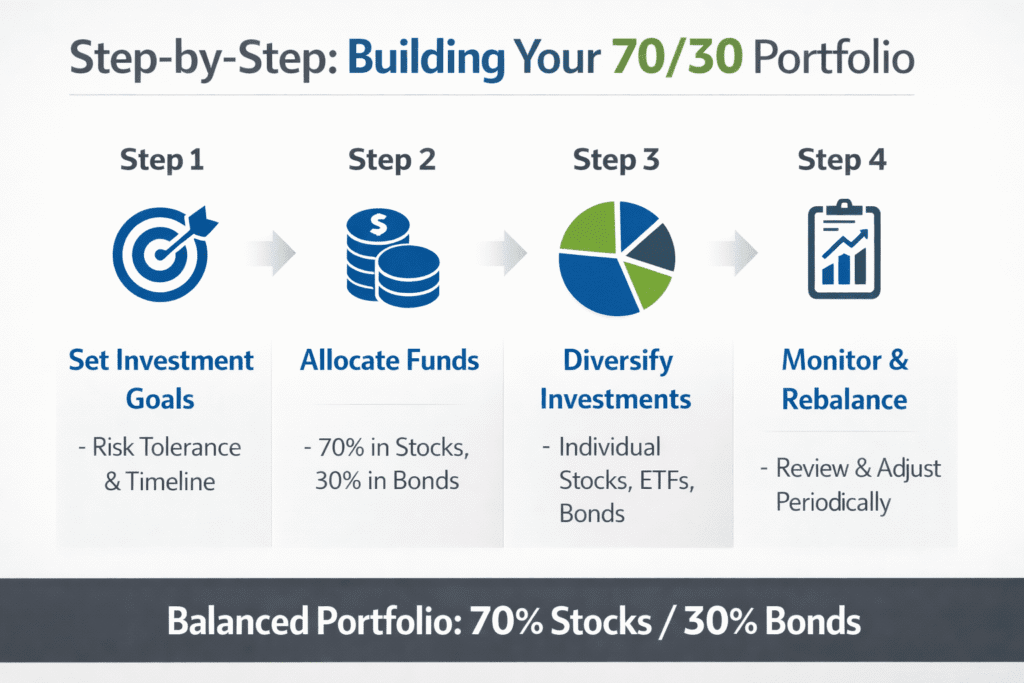
How to Build a 70/30 Portfolio Step by Step
Step 1: Choose Your Stock ETF (The 70% Growth Engine)
You don’t need to pick individual stocks. A single broad-market ETF gives you instant diversification across thousands of companies at a very low cost.
Top options for the 70% equity allocation:
| ETF | What It Tracks | Expense Ratio | Best For |
| VTI (Vanguard Total Stock Market) | ~3,700 U.S. stocks of all sizes | 0.03% | Broadest U.S. diversification |
| VOO (Vanguard S&P 500) | 500 largest U.S. companies | 0.03% | Large-cap focus, proven track record |
| QQQ (Invesco Nasdaq-100) | 100 largest Nasdaq companies (tech-heavy) | 0.20% | Higher growth potential, more volatility |
| VT (Vanguard Total World Stock) | Global stocks (U.S. + international) | 0.07% | Maximum global diversification |
Recommendation for most investors: VTI or VOO. Both are extremely low cost, broadly diversified, and have decades of proven performance. If you want to add global exposure, consider splitting the 70% between a U.S. fund and an international fund like VXUS.
Step 2: Choose Your Bond ETF (The 30% Stability Anchor)
The bond portion’s job is to cushion your portfolio during stock market downturns and generate steady income. Low-cost bond ETFs are the simplest way to implement this.
Top options for the 30% bond allocation:
| ETF | What It Holds | Expense Ratio | Best For |
| BND (Vanguard Total Bond Market) | Broad mix of U.S. bonds | 0.03% | Simple, diversified fixed income |
| AGG (iShares Core U.S. Aggregate Bond) | U.S. investment-grade bonds | 0.03% | Similar to BND, slight differences in weighting |
| SHY (iShares 1-3 Year Treasury Bond) | Short-term U.S. Treasuries | 0.15% | Lower rate sensitivity, very stable |
| TIPS (iShares TIPS Bond) | Inflation-protected U.S. Treasuries | 0.19% | Protection against inflation |
Recommendation: BND for most investors. It’s broadly diversified across investment-grade bonds, has one of the lowest expense ratios available, and is widely held and liquid.
Step 3: Set Up Automatic Contributions
The most powerful thing you can do after choosing your ETFs is automate your investing. Setting up a monthly automatic contribution means you invest consistently regardless of what the market is doing — this is called dollar-cost averaging, and it eliminates the temptation to time the market.
For every $10,000 you invest:
- $7,000 → your stock ETF
- $3,000 → your bond ETF
For a $500 monthly contribution:
- $350/month → stock ETF
- $150/month → bond ETF
Set this up through your brokerage’s automatic investment feature and you’ve essentially put your wealth building on autopilot.
Step 4: Rebalance Once Per Year
Over time, stock market gains will cause your equity allocation to drift above 70%. Rebalancing brings it back to the target split. You only need to do this once a year.
How to rebalance:
- Check your current portfolio value and calculate the actual percentage in each ETF
- If stocks are above 70%, sell enough to bring it back; redirect that money into bonds
- If stocks are below 70% (after a market downturn), buy more stock ETF
Tip: In tax-advantaged accounts (401k, IRA), rebalancing has no tax consequences. In taxable brokerage accounts, consider rebalancing by directing new contributions toward the underweighted asset rather than selling to avoid triggering capital gains taxes.
How the 70/30 Rule Works in a 401(k)
The 70/30 rule applies directly to your 401(k) — and this is actually where it has been most proven. Research on 401(k) millionaires consistently shows that the investors who reach seven-figure balances are not the ones chasing hot stocks. They are the ones who maintained a disciplined allocation — typically around 70% equities and 30% fixed income — for 20–30 years, contributed consistently, and let compound interest do the heavy lifting.
Inside a 401(k), most target-date funds automatically maintain a similar allocation for investors in their 40s and 50s. If you prefer to manage it yourself, choose a broad stock index fund for the 70% and a bond index fund for the 30%, then contribute the maximum allowed each year ($23,500 in 2025 for those under 50, $31,000 for those 50 and older).
The Power of Compound Interest in a 70/30 Portfolio
Compound interest is the reason disciplined, long-term investors with modest contributions build extraordinary wealth. In a 70/30 portfolio earning a historical blended return of around 8–9% annually, here is what consistent monthly investing looks like:
| Monthly Contribution | 10 Years | 20 Years | 30 Years |
| $250/month | ~$45,700 | ~$147,000 | ~$375,000 |
| $500/month | ~$91,400 | ~$294,000 | ~$750,000 |
| $1,000/month | ~$182,800 | ~$589,000 | ~$1,500,000 |
Based on an 8.5% average annual return. For illustrative purposes only.
The most important variable in this table is not how much you invest — it is how long you invest. A person who starts at 25 and contributes $500/month for 30 years will end up with significantly more than someone who starts at 40 and contributes $1,000/month for 20 years, even though the second person put in more money. Time in the market matters more than the size of the contribution.
Common Mistakes to Avoid with the 70/30 Rule
1. Abandoning the strategy during downturns The 70% equity allocation will decline during bear markets. This is expected and temporary. Investors who sell their stock ETF when markets drop 20–30% lock in those losses and miss the recovery. Staying the course is the single most important discipline.
2. Neglecting to rebalance After a strong bull market, your equity allocation may drift to 80% or higher without rebalancing. This increases your risk profile beyond what you intended without you realizing it.
3. Ignoring fees The ETFs listed above have expense ratios of 0.03% to 0.20%. Actively managed mutual funds often charge 1% or more. Over 30 years, that 1% difference can cost you hundreds of thousands of dollars in lost compounding.
4. Applying the same allocation regardless of age A 55-year-old approaching retirement should not have the same 70/30 split as a 35-year-old. Adjust your allocation as your time horizon shortens. A common guideline is to subtract your age from 110 to determine your equity percentage (e.g., at age 55, consider 55% equities).
5. Treating it as a set-and-forget strategy permanently The 70/30 rule requires annual rebalancing and periodic reassessment of whether the allocation still matches your goals, risk tolerance, and time horizon.
FAQ
What is the 70/30 rule in investing?
The 70/30 rule in investing is an asset allocation strategy where 70% of your portfolio is invested in stocks or equity-based funds for long-term growth, and 30% is invested in bonds or fixed-income assets for stability. It is designed to balance growth potential with downside protection, making it suitable for medium-to-long-term investors with a medium-high risk tolerance.
Is the 70/30 rule good for beginners?
Yes, the 70/30 rule is beginner-friendly because it requires only two low-cost ETFs and minimal active management. However, beginners should understand that the 70% equity allocation will decline during bear markets, sometimes significantly. If you are uncomfortable with potential short-term losses of 25–30%, you may want to consider a more conservative 60/40 allocation until you gain more experience.
What ETFs should I use for a 70/30 portfolio?
For the 70% equity portion, VTI (Vanguard Total Stock Market) or VOO (Vanguard S&P 500) are the most commonly recommended options. For the 30% bond portion, BND (Vanguard Total Bond Market) or AGG (iShares Core U.S. Aggregate Bond) are solid choices. Both components can be built with expense ratios as low as 0.03%, keeping costs minimal.
How does the 70/30 rule compare to the 60/40 rule?
The 70/30 rule allocates more to equities than the 60/40 rule, which means higher long-term growth potential but also more volatility. Historically, the 70/30 portfolio has returned roughly 0.5–1% more per year than the 60/40, but also experienced deeper losses during bear markets. The 60/40 is more appropriate for conservative investors or those within 5–10 years of retirement, while the 70/30 suits investors with longer time horizons.
How often should I rebalance a 70/30 portfolio?
Once per year is sufficient for most investors. Pick a consistent date — such as the first of January or your birthday — and check whether your allocation has drifted significantly from 70/30. If it has, buy or sell to bring it back to target. In tax-advantaged accounts, you can also rebalance by directing new contributions toward the underweighted asset class.
Does the 70/30 rule change as I get older?
Yes. The 70/30 split is generally suited to investors aged 30–55. As you approach retirement, it is common to shift to a more conservative allocation, such as 60/40 or 50/50, to reduce exposure to stock market volatility and protect capital you will need to draw on soon. A simple guideline is to subtract your age from 110 to determine your approximate equity percentage.
This article is for informational and educational purposes only. It does not constitute financial advice. Consult a qualified financial advisor before making investment decisions.